Click here to go back.
TESTS PERFORMED ON ANIMALS
In the Lethal Dose:50 test (LD:50), mice, hamsters and other animals are force fed household products or personal care items. A feeding syringe is forced down the animals’ throats, injecting a chemical ingredient of the product, or the product itself, into their stomachs. These animals endure ulcerations, vomiting, bleeding, convulsions, and death. This forced feeding increases in amount until half of them die. Notes are made as to the quantity needed to kill 50% of the animals, then the survivors are killed. No harmful effects are noted or measured, only the animals’ lethal dose. Scientists mistakenly perceive these results as determinant of how much of the product a human can safely ingest.
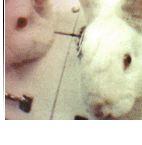
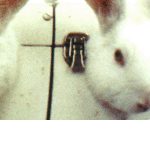
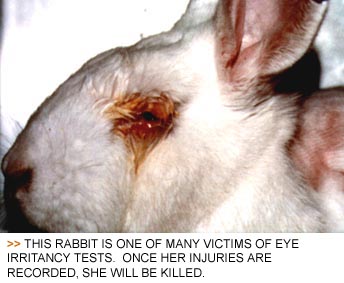
In the Draize Eye Irritancy test, rabbits are immobilized by their necks and have a chemical constituent of product, or a concentrated form of the product itself put directly into their eyes. Unlike humans, rabbits have insufficient tear ducts, so the product doesn’t get washed away naturally. Instead it sits in the eye, causing continuous injury and suffering. The rabbits are known to try so hard to be able to reach their eyes that they often break their neck or back. An individual experiment can last for weeks, and no pain relief is given to the rabbits, as it would “interfere” with the results. Observations are noted subjectively, with no determined scale or range, then extrapolated onto the human population. What one scientist describes as “mild irritation” another may describe as “severe.” Not very scientific. The surviving rabbits are killed. However, no scientist or product manufacturing company can accurately predict a human eye’s response to the product based on the Draize test.
The LD:50 and Draize tests are two of the more common tests, but not the only ones:
In inhalation experiments, dogs, guinea pigs and other animals are locked in small, airtight chambers, which are then filled with concentrated fumes. Others have tight masks secured to their faces and filled with the vapors. The frightened, confused animals are forced to breath these chemicals. They are then locked up and observed. These animals suffer from pain, vomiting, bleeding, convulsions, and death. Once again, no pain relief is given as it would “interfere” with the results. The survivors are then killed, and results mistakenly generalized onto the human population.
In skin irritancy experiments, animals, usually rabbits, have their outer layers of skin removed so that a chemical can be rubbed directly into their abrasions. These animals suffer ulcerations, bleeding, burning, and pain from these procedures as the substance eats away at their skin . Reactions are not treated to provide pain relief, only coldly studied. Once the observations are noted, the animals are killed.